Cluster for atherothrombosis and individualized medicine
A consortium of leading partners from academia and industry is working together to redefine the treatment of cardiovascular diseases. Using artificial intelligence, we identify disease-relevant factors and develop precision medicine approaches that reduce the risk, impact and mortality associated with cardiovascular diseases. Since 2026, our BMFTR-funded cluster is successfully in its second implementation phase.
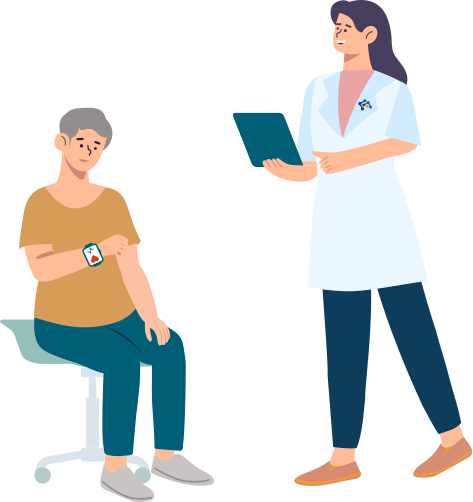
In the curAIAlert project, Philipp Busch of Mind Games and Daniel Dürr, a cardiac surgeon at the University Medical Center Mainz, are collaborating on the development of an AI-powered wearable warning system for heart failure patients. By combining data from wearables, medical records, and patient-reported outcomes, the system aims to detect early signs of deterioration and enable timely interventions.
Drawing on its expertise in gamification and serious games, Mind Games will help create engaging features that promote treatment adherence and healthier lifestyles.
We warmly welcome Mind Games to the curATime consortium and look forward to jointly advancing innovative solutions for heart failure care.
curATalk Steffen Massberg - 29.09.2026
Crosstalk of immunity and thrombosis – novel targets for vascular disease and beyond
Director of the Medical Clinic and Polyclinic I, LMU University Hospital, Munich
The seminar will be held on-site at University Medical Mainz, Seminar room 2, Building 708.
Successfull Kick-off event for the 2. phase
With the kick-off event on September 8, 2026, at DFKI in Kaiserslautern, we have officially launched the second funding phase. The event gave the partners the opportunity to introduce themselves, get to know the entire cluster, and thereby identify valuable synergies. The positive atmosphere and the in-depth discussions demonstrated how important close collaboration within the cluster—as well as a strong network—are for developing innovative solutions in cardiovascular medicine. We were particularly pleased to welcome Clemens Hoch, Minister of Science, Further Education, and Health for the State of Rhineland-Palatinate. We rounded off the successful day with a barbecue, which provided further opportunities for conversation, networking, and personal interaction.
curATime at leading scientific meetings in asia
As part of several international research visits, our Cluster Spokesman Johnny Kim presented current research findings in China and South Korea, while also highlighting the collaborative work of the curATime Cluster. At the 2026 KSSCR Annual Meeting in Seoul, he delivered a presentation entitled “Epigenetic Plasticity in Aging, Regeneration, and Disease.”
His contributions underline curATime’s growing international visibility and promote scientific exchange with researchers around the world.
Welcome to the team!
We are delighted to welcome a new member to the curATime team: Prof. Philipp Lurz, Director of the Center for Cardiology at University Medical Center Mainz, is now actively supporting the curASonic project: “curATime is more than just a cluster of excellence. curATime is creating an ecosystem of innovation in the Main-Rhine region and in Rhineland-Palatinate, which will enable us, working together as a team, to rethink and redesign treatment strategies for atherosclerosis! Personally, I will contribute my clinical expertise in the field of cardiovascular medicine and, from a scientific perspective, our clinical mechanistic models and approaches to reverse translation.”
By bringing together powerful players from science and industry with complementary skills, we are meeting the challenge of tailoring the treatment of atherothrombosis-related cardiovascular diseases.
In curATime, we want to use artificial intelligence to identify disease-relevant factors that link to causes of atherothrombosis. Furthermore, we want to identify molecularly defined precision interventions and hope that by applying these we will be able to reduce the incidence and impact of cardiovascular diseases and therefore to significantly reduce mortality in the population.
Highlights from our kick-off event for the second funding phase
On September 9, 2026, we gathered in Kaiserslautern to officially launch the second phase. For more information, see our Past Events section.
Kaiserslautern September 08 2026
The challenge
Atherothrombosis is the world's No. 1 cause of death
Death rates continue to rise every year
In addition to the high mortality rate, cardiovascular diseases can severely impair the quality of life of those affected by it.
No significant progress has been made in medical research in recent decades
There is an urgent need for new, personalized therapy options
Our solution
Precise targeting of disease-relevant mechanisms through AI- and mRNA-based technologies.
For this purpose, individualized and subgroup-specific profiles for atherosclerotic biomarkers and risks will be developed using AI-supported and state-of-the-art bioinformatics. The findings will be used to develop innovative diagnostic, preventive and therapeutic concepts. This includes the generation of novel algorithms to improve therapy selection and risk assessment as well as eHealth apps and smart devices. Central to the success of the cluster are large data sets from representative population studies and their computer-based analysis using artificial intelligence.